Neive: past, present and future
When a hill was terraced to build a village
These days, and through the world of wine, the Alta Langa is rediscovering its unique landscape architecture: the terraces that are being repurposed for a new, niche “vertical” winemaking future. Over the centuries, they were built to reclaim a little extra land from impossible slopes for humble, self-sufficient agriculture.
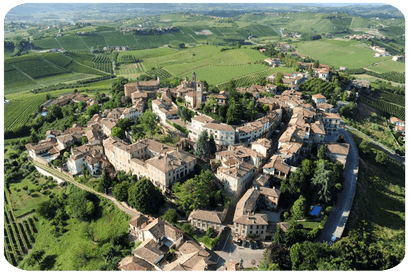
Even the Bassa Langa was terraced in the Middle Ages, but for the opposite purpose: to reclaim as little good land as possible from rich agriculture in the construction of settlements. A hill was taken and adorned with houses, starting at the top—almost always with a castle and tower watching over the plain—and then working down the slopes, cutting, levelling, and supporting the foundations created with dry stone walls, mortar, or the houses themselves.
And the historic centre of Neive is perhaps the one that made the most use of this technique, as it has not a single meter of streets, squares, gardens, or courtyards that isn’t supported by a low wall or a house.
Origin
Noblemen, with a walled settlement at the summit, founded Neive, like many other towns. A castle was built at the centre of the settlement around the year 1000 to defend the site from the Saracens, who had almost certainly occupied the area between the 9th and 10th centuries.
Partially destroyed in 1274 by the Asti family, who had seized the territory of Neive as a strategic outpost in the centuries-old struggle with Alba, it passed through various hands until Commendatore Luigi Rocca, who built his summer residence next to the tower, demolished the remains.
The 18th Century, the Golden Age
The completion of construction within the “enclosure” culminated in the 18th century, the “golden age” of Neive’s urban development, when the town took shape and truly became “the best in the Langhe region,” as notary Domenico Sansoldo put it in 1760.
Decadence…how a railway can transform a reality
Things began to change for Neive as a historic centre when, one day in May 1865, its people flocked down to the valley to greet the passage of the first train of the new Cavallermaggiore-Alessandria railway.
If for the historian Vada, 1865 was the year of the true birth of Borgonuovo, it is fitting to add that it also marked the beginning of the decline of the town that once stood up there.
Commerce, artisanal activities, the weekly market, religious activities, the medical clinic, and schools all moved down to the plains.
Rebirth and tourism boom
Then the winds shifted again, this time in the right direction, toward the future.
Times changed, and administrations emerged that approached the problem with a fresh vision.
New cultural sensibilities and stimuli emerging in those years helped. There was a growing need to delve into the past, to seek out authentic sites, still intact, untouched by the colder and more distant construction of consumerism.
And Neive, an ancient village, discovered itself to be the ideal place to embrace these needs, and in a couple of decades it was able to reverse a destiny to which progress had seemingly condemned it. It was helped to gain recognition by figures in literature, classical music, industrial design, grappa contaminated by art, niche restaurants, and the world of wine, the true engine of recovery, with its ancient and new cellars, ennobled by the arrival of no less than four designations of origin for its great wines.
Subscribe to our newsletter
Sign up for our newsletter to stay up-to-date on the latest Francone Vini news and receive exclusive offers and events related to our wines.